CAPES Global.Edu Program at UFPR
Global South 2030 Network for Scientific Cooperation and Sustainable Development
The Global South 2030 Network for Scientific Cooperation and Sustainable Development is a strategic initiative coordinated by the Federal University of Paraná with the aim of promoting collaborative internationalization between institutions from different regions of Brazil, in partnership with foreign institutions. The proposal is aligned with the objectives of the PNPG (National Postgraduate Plan) 2025-2029. This portal brings together key information about the proposal, actions, opportunities, and ways to participate. This page is also available in Portuguese.

ABOUT THE NETWORK
Associated HEIs/IPs
In addition to UFPR, the coordinating HEI of the Sul Global 2030 Network, five institutions comprise the network as associates:
- VALE DO ACARAÚ STATE UNIVERSITY (Northeast)
- STATE UNIVERSITY OF MIDWEST (South)
- FLUMINENSE FEDERAL UNIVERSITY (Southeast)
Justification for composition
The composition of the South Global 2030 Network was strategically designed to maximize scientific complementarity and impact in three priority thematic areas: Inclusion and human development; Conservation and sustainable production; and Frontiers of innovation. Bibliometric analysis of the scientific output of the partner institutions reveals a remarkable synergy that justifies their specific formation.
The network includes 88 postgraduate programs out of a total of 208 postgraduate programs based at these institutions, with the capacity for cooperation on multiple fronts in thematic strategies. The regional diversity of the network and the combination of institutions at different stages of internationalization ensure that the benefits of international cooperation are distributed equitably, promoting the reduction of asymmetries and the collective strengthening of the Brazilian higher education system.
This composition not only adds expertise, but multiplies it, creating a research ecosystem capable of addressing complex problems in an interdisciplinary and interinstitutional manner, generating high-impact solutions to contemporary global challenges.
For further information about the CAPES Global.Edu Program, consult the official website: www.gov.br/capes/…/programa-capes-global.edu
Strategic Themes
The definition of strategic themes for the South Global 2030 Network proposal was based on an analysis of the intellectual output of the network’s institutions, which revealed remarkable synergy and complementary expertise that comprehensively and strategically covers the 17 Sustainable Development Goals (SDGs) of the United Nations 2030 Agenda and further enhance the quality of internationalization at the national level.
After a series of meetings between researchers and the Pro-Deans, three thematic axes were defined for conducting the projects:
- Inclusion and Human Development: Integrated Solutions for Health, Education, and Social Justice
- Conservation and Sustainable Production: Socio-Environmental Governance of Land, Water, and Biodiversity
- Frontiers of Innovation: Science and Digital Transformation for a Sustainable Future
In the first theme, UFPR and UFF present robust scientific production in SDG 3 and SDG 4, demonstrating consolidated critical mass in areas such as public health, human resources training, and educational policies. UNICENTRO contributes with strong performance in SDG 3, focused on public health and primary care. UVA and IFSP, in turn, stand out in SDG 4. The former focuses on teacher training and basic education in the Northeast, a priority region for reducing educational inequalities, and the latter on technological education in the Southeast. IBICT contributes with unique expertise in SDG 5 and SDG 16, bringing perspectives on democratizing access to scientific information and knowledge governance, which are essential for social inclusion and equitable human development.
The second theme brings together highly specialized expertise in sustainability. UFPR and UNICENTRO demonstrate excellence in SDG 15, UFPR with research in biodiversity, conservation, and ecosystem management, and UNICENTRO with regional insertion in areas of high biodiversity and research in agroecology and sustainable production systems. UVA complements the theme with research focused on the ecosystems of the northeastern semi-arid region, expanding the diversity of biomes covered by the network and strengthening the capacity to address specific regional environmental challenges.
Finally, in the third theme, IFSP emerges as a strategic partner, presenting exceptional performance in SDG 7 and SDG 9. Its expertise in renewable energy and applied innovation complements the network’s profile, creating opportunities for technology transfer and the development of innovative solutions. UFPR and UFF, with strong performance in SDG 9, contribute with research in engineering, materials science, and biotechnology. IBICT, with its specialization in information science, provides essential knowledge on scientific data management, information infrastructure, and impact metrics, which are fundamental elements for the digital transformation of science and innovation governance.
Research Projects
Fifteen international cooperation research projects will be developed during the program’s duration, distributed among the three themes:
| INCLUSION AND HUMAN DEVELOPMENT: INTEGRATED SOLUTIONS FOR HEALTH, EDUCATION, AND SOCIAL JUSTICE |
|---|
| 1 – The dynamics of biological systems in prevention, determinants, diagnosis, and health therapies |
| 2 – Public Policies, Spaces, and Social Dynamics |
| 3 – Production, circulation, and translation of knowledge and social challenges |
| 4 – Inclusion, human rights, and democracy |
| 5 – GAIA-URIHI: Memory, identities, and digital citizenship |
| CONSERVATION AND SUSTAINABLE PRODUCTION: SOCIO-ENVIRONMENTAL GOVERNANCE OF LAND, WATER, AND BIODIVERSITY |
|---|
| 1 – Biodiversity and the environment: threats and conservation of biodiversity |
| 2 – Evolution of Biodiversity: multidisciplinary approaches |
| 3 – Climate change, monitoring, modeling, and environmental impacts |
| 4 – Sustainability, sustainable technologies and production systems in food security |
| 5 – Agroecology and socio-environmental justice: fair transition of agri-food production in the context of climate emergency |
| 6 – Omic Sciences for Agriculture, Sustainability, and Biodiversity |
| FRONTIERS OF INNOVATION: SCIENCE AND DIGITAL TRANSFORMATION FOR A SUSTAINABLE FUTURE |
|---|
| 1 – Advanced (nano)materials and biomaterials: preparation, characterization, modeling, study of properties and applications |
| 2 – Mathematical and computational modeling, artificial intelligence, and data analysis applied to global technical-scientific and socio-cultural challenges |
| 3 – Engineering and circular economy: conversion of waste into advanced biofuels and bioproducts |
| 4 – Science, Technology, and Innovation Policies and the Regulation of Emerging Technologies: challenges for achieving the Sustainable Development Goals (SDGs) at the local and global levels |
Postgraduate Programs
At UFPR, 69 Postgraduate Programs have joined the Global South 2030 Network:
| ACCOUNTING |
| AGRONOMY (PLANT PRODUCTION) |
| ANIMAL SCIENCE |
| ANTHROPOLOGY AND ARCHAEOLOGY |
| AQUACULTURE AND SUSTAINABLE DEVELOPMENT |
| BIOINFORMATICS |
| BIOLOGICAL SCIENCES (ENTOMOLOGY) |
| BIOPROCESS AND BIOTECHNOLOGY ENGINEERING |
| BIOTECHNOLOGY |
| BOTANICS |
| CELL AND MOLECULAR BIOLOGY |
| CHEMICAL ENGINEERING |
| CHEMISTRY |
| CHILD AND ADOLESCENT HEALTH |
| CIVIL ENGINEERING |
| COASTAL AND OCEANIC SYSTEMS |
| COLLECTIVE HEALTH |
| COMMUNICATION |
| ECOLOGY AND CONSERVATION |
| ECONOMIC DEVELOPMENT |
| ECONOMY |
| EDUCATION |
| EDUCATION: TEACHING THEORY AND PRACTICE |
| ELECTRICAL ENGINEERING |
| ENVIRONMENT AND DEVELOPMENT |
| ENVIRONMENTAL ENGINEERING |
| FAMILY HEALTH |
| FOOD AND NUTRITION |
| FOOD ENGINEERING |
| FORESTRY ENGINEERING |
| GENETICS |
| GEODETIC SCIENCES |
| GEOGRAPHY |
| HEALTH CARE PRACTICE |
| HISTORY |
| INFORMATICS |
| INFORMATION MANAGEMENT |
| INTERNAL MEDICINE AND HEALTH SCIENCES |
| LANGUAGES AND LITERATURE |
| LAW |
| MANUFACTURING ENGINEERING |
| MATERIALS SCIENCE AND ENGINEERING |
| MATHEMATICS |
| MECHANICAL ENGINEERING |
| MICROBIOLOGY, PARASITOLOGY AND PATHOLOGY |
| MUSIC |
| NATIONAL NETWORK FOR TEACHING ENVIRONMENTAL SCIENCES |
| NURSING |
| ODONTOLOGY |
| PHARMACEUTICAL SCIENCES |
| PHARMACOLOGY |
| PHILOSOPHY |
| PHYSICS |
| POLITICAL SCIENCE |
| PRODUCTION ENGINEERING |
| PROFESSIONAL PHILOSOPHY |
| PUBLIC POLICY |
| SCIENCE (BIOCHEMISTRY) |
| SCIENCE AND MATHEMATICS EDUCATION |
| SCIENCE EDUCATION, MATHEMATICS EDUCATION, AND EDUCATIONAL TECHNOLOGIES |
| SOCIOLOGY |
| SOCIOLOGY IN THE NATIONAL NETWORK |
| SOIL SCIENCES |
| SUSTAINABLE TERRITORIAL DEVELOPMENT |
| TOURISM |
| URBAN AND INDUSTRIAL ENVIRONMENT |
| URBAN PLANNING |
| WATER RESOURCES AND ENVIRONMENTAL ENGINEERING |
| ZOOLOGY |
Steering Committee
The Steering Committee will be the deliberative and strategic body responsible for the overall coordination of the Network, defining guidelines and making decisions that guide its implementation. The Committee will be responsible for establishing priorities, approving work plans and budgets, monitoring the fulfillment of agreed goals, evaluating results, and deliberating on institutional replanning and partnerships.
It is composed of institutional representatives from the HEIs that are part of the Network, including a pro-dean (or equivalent) and a member of the international relations office from each participating institution. This composition ensures representativeness, decision-making legitimacy, and direct coordination between the areas responsible for postgraduate studies, research, and international cooperation, promoting integration between partner institutions.
The chair of the Steering Committee is held by Prof. Edneia Amancio de Souza Ramos Cavalieri, Pro-Dean of Postgraduate Studies at UFPR.
Governance Plan
The Global South 2030 Network will work cooperatively to reduce regional and institutional asymmetries in the development of internationalization, considering the academic maturity of each HEI/IP, its infrastructure, and the current status of its international integration.
Based on the planned actions, activities will be prioritized considering: 1) proposed objectives, 2) infrastructure and logistical support necessary for implementation, 3) visualization of the results of the actions, considering long-term planning for data collection.
The Network will also have a permanent program for the exchange of internationalization management practices between hubs, campuses, and administrative units, and will implement an integrated system for sharing and disseminating scientific and technical knowledge, in line with open science and collaborative information management policies, strengthening the institutional capacity of Network members.
The communication of the Global South 2030 Network will be structured as a strategic axis for institutional strengthening and consolidation of Brazil’s presence on the international scientific scene. The proposal has an integrated and collaborative approach between institutions and promotes the circulation of information, results, and experiences that express the regional and thematic diversity of cooperation.
With regard to control, monitoring, and risk management, the Network’s actions will be conducted collaboratively, based on a continuous cycle of planning, execution, verification, and improvement (PDCA). The process will ensure systematic monitoring of the Action Plan’s goals and results, in coordination between the Steering Committee, responsible for strategic supervision, and the Administrative Committee, responsible for consolidating and analyzing technical, financial, and operational data.
Monitoring will adopt a participatory methodology, allowing all institutions to contribute to the identification of risks and solutions. Management tools such as SWOT and GUP (Severity, Urgency, and Probability) analysis will be used to prioritize corrective actions and optimize execution.
Contact
For general inquiries regarding the Network, contact exclusively by email:
E-mail: propginternacional@ufpr.br
PROPOSAL CONSTRUCTION
Timeline
First Steps
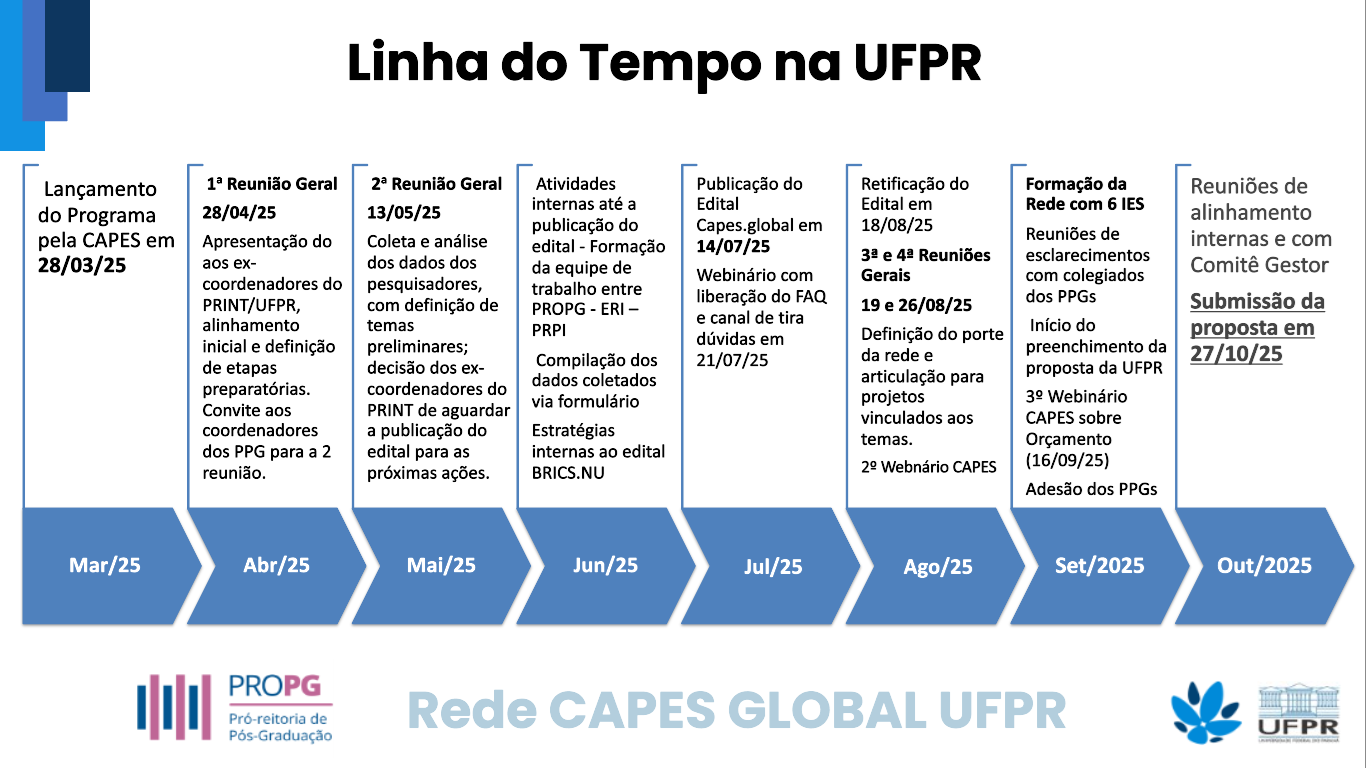
Since the launch of CAPES Ordinance No. 74/2025 on March 28, 2025, which established the Networks for Institutional Internationalization Program – CAPES Global.edu, UFPR has been carrying out a series of preparatory actions for the development of its proposal. In April, the first general meeting with the academic community was held, at which the program’s objectives were presented and the first steps were defined, including gathering information from the Postgraduate Programs (PPGs). In the following months, this survey was systematized through questionnaires applied to the PPGs, allowing for the mapping of existing international partnerships, installed capacities, and potential for expansion.
In May, the second general meeting enabled discussion of the data collected and preliminary definition of strategic themes, with the decision to wait for the publication of the call for proposals to consolidate planning. Subsequently, a Technical Working Group was established, tasked with analyzing the requirements of the call for proposals, organizing the information gathered, and structuring the basis of the institutional proposal.
Stages of Proposal Development
With the publication of the Call for Proposals No. 13/2025 in July, the consolidation phase of the UFPR proposal began, with debates on the composition of the network of partner institutions, eligibility criteria, budget, and linking projects to strategic themes. The meeting on August 20, 2025, marked the stage of defining the main steps, including setting the number of associated institutions, distributing projects, and providing guidance for nominating new partners.
In September, the participating HEIs in the network were defined and the postgraduate programs were invited to express their interest in joining the proposal. Following the third CAPES webinar on the budget, a series of internal meetings and meetings with the network’s steering committee were held to consolidate the themes and projects and fill in the necessary items in the system.
This process highlights UFPR’s collective effort to coordinate its academic units, coordinate the PPGs, and align the institutional proposal with CAPES Global’s objectives in order to strengthen internationalization, expand strategic partnerships, and ensure leadership on the national and international stage.
Equitable Distribution
The “Global South 2030 Network for Scientific Cooperation and Sustainable Development” aims to reduce regional asymmetries by linking research and teaching institutions to strengthen international cooperation with foreign HEIs in the global south, adhering to the themes given by the profile of HEI publications from the Scival/OpenAlex platforms.
Thus, equitable distribution considered both the size of the associates and asymmetry criteria to promote the development of the institutions, combined with the representative proportion of postgraduate programs that were included in the themes, adding additional value to the institutions that remained exclusive to the UFPR network.
For budget calculation purposes, South Global 2030 Network has a total of 209 Postgraduate Programs (PPGs), reaching the top of the budget established annually by Capes Call for Proposals 13/2025. UFPR had 69 eligible PPGs (76% of its total), UFF joined the network with 4 PPGs (5% of its total), IFSP with 2 (50%), UNICENTRO and UVA with 6 PPGs (representing, respectively, 32% and 86% of their total programs), and IBICT with 1 PPG (100%).
UFPR has 41 Postgraduate Programs in theme 1, 43 in theme 2, and 38 in theme 3. All members participate in theme 1, while UNICENTRO, UVA, and IBICT participate in theme 2, and UFF, IFSP, and IBICT participate in theme 3.
A minimum amount of 3% of the budget was established for each HEI, with an additional 1.5% for each extra linked PPG. In terms of budget execution, 25% of the amount was allocated to missions and costs, and 75% to scholarships.
Minutes of General Meetings
Minutes of the meeting on August 19
Continuing the process of collaborative construction of the Network, PROPG invited the academic community, especially the coordinators and faculty of stricto sensu postgraduate programs, to participate in the third general meeting.
Held on August 19, 2025, the meeting focused on the presentation of the CAPES Global.edu Program – Networks for Institutional Internationalization, highlighting its differences from the former CAPES PRINT.
While PRINT focused on a single institution, Global.edu seeks to consolidate networks composed of 4 to 6 HEIs, distributed in different regions of the country, with requirements for academic excellence, consolidated international partnerships, and the inclusion of postgraduate programs at different levels (academic and professional, grades 3 to 7) with a focus on reducing internationalization asymmetries among HEIs in the network.
The requirements for coordinating and associated institutions, the composition of networks, and the possibilities for participating in more than one proposal were discussed. The financing modalities and scholarships provided were also detailed, covering international work missions, project funding, and scholarships abroad and in Brazil, such as sandwich doctorates, postdoctoral fellowships, visiting professorships, and young talent scholarships. In addition, the necessary governance structure was presented, with management and administrative committees, theme coordination, and research project coordination.
In the case of UFPR, the analysis of strategic areas was based on scientific production data and the Sustainable Development Goals (SDGs). Based on this analysis, it was suggested that a network be formed with partner institutions from different regions of the country, including some already prospected, such as UFU. Considering a network of six institutions, the inclusion of a regional partner, such as UEM, was also proposed, which could contribute to greater visibility with the Araucária Foundation and strengthen the link between projects and each theme. In addition, a preliminary budget calculation was presented, estimated at up to R$ 20 million per year for networks of this size.
Referrals:
At the end of the meeting, it was decided that the UFPR network will have six associated institutions; the projects will be organized into three themes, with five projects linked to each one; and researchers will be responsible for indicating possible additional partner institutions, preferably smaller HEIs/RIs, which only have PPGs with grades 3, 4, or 5. Nominations must be made by August 26, 2025, using the form available at: https://forms.office.com/r/TVPJ3DZRpw.
The presentation used at the meeting and the recording of the meeting can be accessed at the links below, by logging in @ ufpr:
- Presentation 08/19/25, spreadsheet with total PPGs per HEI and CAPES documents:
Link para acesso
- First part of the meeting:
Link para acesso
- Second part of the meeting:
Link para acesso
Schedule of actions:
After the thematic meetings held on September 22 and 23, the projects were forwarded for debate and structuring, with the appointment of the respective coordinators. The chosen coordinators must complete the project registration form and submit the relevant documentation within the following deadlines:
By September 26, 2025: Submit the names of the theme and project coordinators, as well as the project titles.
By October 1, 2025: Submit the updated syllabus texts and project summaries, as well as the action forms – missions, scholarships, funding
The annexes to the Call for Proposals that provide guidance on budget calculation, as well as other important documents, can be found here.
Thematic Meeting Minutes
The meetings to discuss the projects linked to each theme related to the proposal took place in a hybrid format on September 22 (Theme 2) and September 23 (Themes 1 and 3). The recordings of the meetings are available for access at the links below:
FAQ
Frequently Asked Questions:
- Can a Postgraduate Program (PPG) be in more than one theme?
Yes. A Postgraduate Program is allowed to participate in more than one theme within the same network. However, participation in more than one network is not allowed. PPGs are also allowed to choose not to join CAPES Global.
- Can professional PPGs participate?
Yes. Both professional and academic programs may participate, provided they have grades between 3 and 7 and have already completed at least one evaluation cycle.
- Are PPGs that join CAPES Global prevented from participating in CAPES calls for proposals?
The restriction only applies to CAPES institutional internationalization calls for proposals. Currently, this applies to PDSE and Move La América. In addition to these, any new institutional calls for proposals launched by CAPES in the future will also not allow the participation of postgraduate programs linked to CAPES Global.
- Does joining CAPES Global prevent participation in calls for proposals such as COFECUB and PROBRAL?
No. These calls for proposals are not institutional in nature and, therefore, the participation of PPGs will not be affected. The restriction applies only to existing institutional calls for proposals—PDSE and Move La América—in which PPGs linked to CAPES Global will not be able to compete. Similarly, any new institutional call for proposals launched by CAPES in the future will also not allow the participation of PPGs that are members of CAPES Global.
- Can PRINT projects be used in CAPES Global?
Yes. PRINT projects may be used within the scope of CAPES Global.
INTERNATIONALIZATION AT UFPR

UFPR ranks among the top ten universities in Brazil and among the top 1,000 universities in the world. Our history, marked by pioneering spirit and academic excellence, positions us as a catalyst for strengthening Brazil’s international role, in full alignment with the general objective of the call for proposals. Our recent and successful experience with the CAPES-PrInt Program, which has funded more than 350 international academic actions through 2023, demonstrates our broad capacity for managing and executing complex internationalization projects. This legacy has provided valuable learning and a robust infrastructure through research projects linked to the proposal and consolidated in the Institutional Internationalization Plan (2023-2027) approved by CEPE, which is now being expanded through strategic planning for internationalization in postgraduate studies (2025-2029).
International Relations Office
The International Relations Office (ERI) is the unit that connects UFPR to the world. It consists of actions related to the formalization of international agreements and partnerships, language policies, participation in various international networks, international mobility of students, teachers, and TAEs, and the PEC-G and PEC-PLE agreements.
More information about the ERI is available at: https://internacional.ufpr.br/portal/
Strategic Planning for the Internationalization of Postgraduate Studies
Based on the guidelines of the Institutional Development Plan (2022-2026) and the Institutional Internationalization Plan (2023-2027) of UFPR, the Pro-Dean of Postgraduate Studies Office has established a plan to develop the internationalization of postgraduate studies for the period 2025-2029. The document in English and Portuguese can be accessed below.
International Cooperation Agreements
UFPR has maintained a consistent policy of signing international cooperation agreements over the last few years in various regions of the world.
Although the university has partners in all geographic regions, the most significant are Europe, with 375 agreements signed between 2017 and 2024, and Latin America and the Caribbean, in second place, with 80 cooperation agreements signed.
The current agreements can be accessed at: https://internacional.ufpr.br/portal/acordos-vigentes/
International Mobility
UFPR has extensive experience in IN and OUT international mobility actions, as well as solid partnerships with foreign institutions, which contribute significantly to the internationalization of postgraduate studies at the university. In recent years, approximately 1,000 international scholarships have been awarded to postgraduate students, professors, researchers, and technicians at the institution, with funding from CAPES, mainly through the CAPES-PrInt Program, and from other sources.
There are records of mobility, with or without signed international cooperation agreements, in the IN and OUT modalities in all regions of the planet, with the most significant actions concentrated in Europe.
Joint supervision and double degrees
UFPR currently has eleven (11) double degree agreements in place for postgraduate studies (master’s and doctorate) with the following institutions: Université Grenoble Alpes (Humanities); Université Lumière Lyon 2 (Humanities); Universität Leipzig (Humanities); Université Stendhal – Grenoble 3 (Humanities); Technische Hochschule Ingolstadt (Mechanical Engineering); Instituto Tecnológico de Aguascalientes (Chemical Engineering); Universität Stuttgart (Urban and Industrial Environment); Universidad del Valle (Nursing); Université de Sherbrooke and Universite Rennes (Philosophy – Tripartite Master’s Degree); Vechta University (Philosophy – Doctorate); Maastricht University (Postgraduate Program in Pharmacology); Université libre de Bruxelles (ULB) (Postgraduate Program in Applied Mathematics).
Between 2020 and 2024, 37 double degrees were awarded, according to information from the PROPG Diplomas and Certificates Unit.dos da PROPG.
From 2017 to 2024, several co-supervision agreements were signed, involving 56 beneficiaries and 28 Postgraduate Programs (PPGs). In this modality, the Postgraduate Programs in Law and Water and Environmental Resources Engineering were the most active, with six doctoral students from each program conducting their thesis under co-supervision. This data shows that internationalization has institutional reach, not restricted to the 18 PPGs of excellence (grades 6 and 7), although it can still be enhanced.
Internationalization of the Curriculum and Promotion of Multilingualism
UFPR has several tools and programs to promote language training and multilingualism among students, technical staff, and faculty, as well as the external community of Curitiba and the metropolitan area. There are several fronts that allow interested members of the public to choose their participation options from different foreign and/or additional language courses.
Concerned with the multilingual and multicultural environment at UFPR, the institution established its Language Policies through Resolution No. 45/2022-CEPE, aiming to democratize internationalization and linguistic diversity. Since then, the Office of International Relations (ERI) has had a Language Policy Coordination Office (CPL) for this purpose. This coordination office acts mainly:
- In the promotion of multilingual and intercultural practices;
- In the personal, professional, social, and human development of language learners;
- Promoting cooperation between institutions through access to linguistic knowledge;
- Assisting in the inclusion of the academic community in the international arena;
- Promoting the Portuguese language to foreigners (as a foreign, additional, or host language), as well as indigenous languages and Brazilian Sign Language (LIBRAS), valuing and disseminating Brazilian identity, culture, and linguistic diversity;
Based on these principles, several language training programs are promoted at UFPR, such as the UFPR Languages Without Borders (IsF) center, the Student Agreement Program – Portuguese as a Foreign Language (PEC-PLE), and the Center for Languages and Interculturality (CELIN), which has several language projects, among others.
Among the internationalization initiatives at home, which aim to transform the UFPR environment into an increasingly welcoming space for international/foreign students, the following stand out: the program to welcome foreign students at UFPR, the publication of a guide for foreign students, the international stands at SIEPE – Integrated Week of Teaching, Research, and Extension, the Reader Professor Program, and the Virtual Exchange/COIL.
Currently, UFPR offers 26 courses in foreign languages, distributed across 18 postgraduate programs, with a predominance of English (24 courses) and two bilingual courses (English-Portuguese). Noteworthy courses include Artificial Intelligence, Seminar in Strategy, Weed Science, Aquatic Toxicology, Physical Metallurgy, Materials for Automation, and Emergent Topics in Tourism.
The International Relations Office, in partnership with the Pro-Dean of Postgraduate Studies Office (PROPG) and the Pro-Dean of Human Resources Office (PROGEPE), launched a series of continuing education courses in 2025 for UFPR faculty members who wish to improve their international courses or begin offering them. The EMI (English as a Medium of Instruction) course had already been offered since 2022, and this year, the ELE (Español como Lengua de Enseñanza) and FLND (Français Langue non Didactique) courses were incorporated into this initiative, promoting institutional multilingualism.
The EMI course took place at the end of September 2025 and was taught by a professor from the English Language and Literature course in partnership with a professor from the Open University (England). Nineteen professors participated in this initiative in person and/or online (broadcast of the in-person course to professors at campuses in the interior and on the coast).
Other Internationalization Initiatives
Entrance exam in several languages
Valuing internationalization at home, UFPR maintains in its traditional entrance exam the option for applicants to choose between five languages to answer foreign language questions, contrary to the national trend of valuing only English and Spanish. Questions (in foreign languages) are offered in the following languages: English, Spanish, French, Italian, and German.
Events promoting international partnerships
UFPR has increasingly promoted events that encourage reflection and the sharing of ideas for international partnerships. This year, from November 4 to 8, 2025, UFPR will hold its Francophone Cultural Week, which will feature workshops, exhibitions, cultural studios, film screenings, and a unique gastronomic experience at the University Restaurants, with a special menu from some French-speaking countries.
More information: https://internacional.ufpr.br/portal/2025/10/07/programacao-semana-francofona-ufpr/
International Extension Project for Refugees: PBMIH
UFPR was the first Brazilian university to create an extension project to teach Portuguese as a Host Language (PLAc) to migrants who are refugees, stateless persons, or humanitarian visa holders. Brazilian Portuguese for Humanitarian Migration (PBMIH) began in 2013, following the earthquake in Haiti. Since then, it has served approximately 300 migrants per semester, offering Portuguese classes every Saturday morning, from beginner to advanced levels. The project involves undergraduate and Postgraduate students in Language and Literature who teach classes to migrant students under the supervision of Language and Literature professors. In addition to the adult class, the project also serves the children of migrants, who receive Portuguese lessons tailored to children and young people while their parents are in class.

This section will progressively gather information from the Global South 2030 Network for Scientific Cooperation and Sustainable Development, in a commitment to transparency and good management of public resources.
ACTIONS
Coming soon.
CALL FOR APLICATIONS
Coming soon.
DOCUMENTS
Coming soon.
Proposal Submitted to CAPES
Coming soon.
Terms of Adhesion and Strategic Plans
Coming soon.
Minutes and Records of the Steering Committee
Coming soon.
Letters of Institutional Support
Coming soon.
BUDGET EXECUTION
Coming soon.
Financial Execution
Coming soon.
Reports
Coming soon.
Assessment and Risks
Coming soon.